Energique® Homeopathic Phenolic Remedies
Isopathic phenolic remedies to desensitize against allergic responses
Energique® Phenolic Remedies
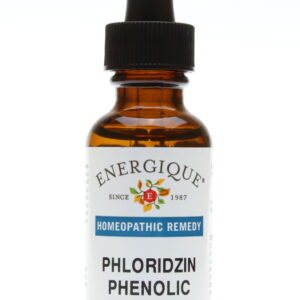
→ Phloridzin Phenolic: Phloridzin is a compound that leads us on many paths. It has been used experimentally to produce glucosuria in animals. Dietarily, we have only one confirmed source: beets (including beet sugar).
Phloridzin was once thought to occur in apples, pears, plums, cherries and other sources; but, so far, has been confirmed only in apple (bark and roots). Nevertheless, it has had great benefit for collagen diseases, and for those with sugar difficulties. The chemical has seen particular interest in sugar cravings.
Phloridzin Phenolic contains phloridzin 6x, 12x, 30x, 12c, 30c and distilled water. 20% ethanol.
→ Quercetin Phenolic: Quercetin is one of the most widespread flavonoids in the plant kingdom. Its presence is signaled by the appearance of yellow coloring. Yellow color shows up in 78% of the plants natural to temperate zones, in vegetative matter and fruits, but especially in flowers. In some instances, the coloring is more rust-red or red-brown, such as in marigolds and red oak. It is especially important in clover and ragweed pollen. The leaves of rhododendron and staghorn sumac contain prodigious amounts.
Quercetin is a metabolite of rutin in the majority of plants; hence, quercetin's coloring may be confused with rutin. Quercetin, along with rutin, represent an important combination in the alleviation of hayfever symptoms. It's especially significant in fall and late summer weeds.
Quercetin Phenolic contains quercetin 6x, 12x, 30x, 12c, 30c and distilled water. 20% ethanol.
→ Rutin Phenolic: Rutin is a flavonoid that, like quercetin, is found widely in the plant kingdom. Its coloring in plants is bright yellow. The single biggest source in flowering plants is perhaps buckwheat, where it represents about 56 lbs. per acre of pollen. Additionally, it is seen in forsythias, tobacco, corn kernels and silk, eucalyptus, ragweed and goldenrod. Although these plants represent only a small fraction of the 700 to 800 plant sources, it's easy to see how valuable it can be.
The primary uses are for hayfever, but it need not be limited to growing seasons. Because it can produce rhinitis in the foods that contain it, rutin has uses throughout the year.
Rutin Phenolic contains rutin 6x, 12x, 30x, 12c, 30c and distilled water. 20% ethanol.
→ Salsolinol Phenolic: Salsolinol is a metabolic product of fermentation found in small amounts in several food sources. Primary among these sources are alcoholic beverages and chocolate. Chocolate contains only slightly less salsolinol than whiskey (chocolate has 40 ug/g and whiskey has 64 ug/m-4.).
Salsolinol is thought to be the addiction principle in alcoholism and chocoholics. Some people have reported that its use has led to alcohol aversion. Additionally, it causes mental fog (not unlike a hangover), throat discomfort and headache. It is also associated with general weakness. Neutralizing salsolinol should counteract all of the above symptoms.
Salsolinol Phenolic contains salsolinol 6x, 12x, 30x, 12c, 30c and distilled water. 20% ethanol.
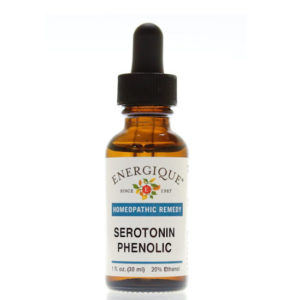
→ Serotonin Phenolic: Serotonin is a significant neurotransmitter. Low levels of this chemical in the body is known to lead to aggressive and suicidal tendencies. It is commonly useful for depression and obsessive-compulsive disorders. Its neutralization has been beneficial in controlling insomnia and its reverse: drowsiness.
Serotonin Phenolic contains serotonin 6x, 12x, 30x, 12c, 30c and distilled water. 20% ethanol.
→ Taurine Phenolic: Taurine is an amino acid found in the bile products of the liver. Its use is centered around the detoxifiying mechanisms of the liver. Taurine is thought to have a pronounced stimulatory effect on biliary output, and the consequent drainage, of the liver.
Taurine Phenolic contains taurine 6x, 12x, 30x, 12c, 30c and distilled water. 20% ethanol.
Energique® Phenolics are another great tool for achieving optimal health. Since I've begun using them, I've been much more able to function in my environment.
Why is that?
It's because many food substances and environmental toxins have sensitizing properties that are related to their phenolic rings, which can create an allergic response in some individuals.
Energique's isopathic phenolic remedies are formulated to assist the body in desensitizing itself to the various foods associated with the phenolic rings in each formulation. Each is formulated in 6-12-30x and 12-30c potencies, with distilled water and 20% ethanol.
These statements have not been evaluated by the Food and Drug Administration. These products are not intended to diagnose, treat, cure or prevent any disease.
Energique® Phenolic Remedies
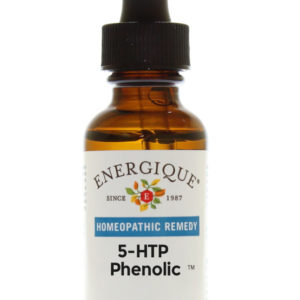
→ 5-HTP Phenolic: 5-HTP is the active form of tryptophan, an essential amino acid. It functions as the precursor to serotonin, and has a definite antidepressant effect. Like serotonin, 5-HTP is beneficial for control of sleep disorders. It also influences the large intestine (where most of the serotonin in the body is found), neutralizing bloating and constipation.
5-HTP Phenolic contains 5-HTP 6x, 12x, 30x, 12c, 30c and distilled water. 20% ethanol.
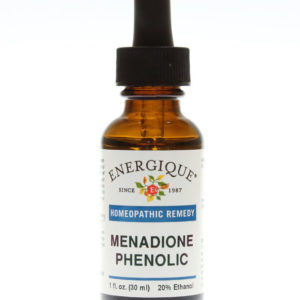
→ Menadione Phenolic: Menadione, commonly known as vitamin K in blood clotting mechanics, is tied to changes in gastrointestinal function. There is no direct test for menadione status in the body, but it can be inferred by prothrombin in the blood. Conventional medicine has noticed a general decline in prothrombin in recent years, which is usually attributed to the routine use of aspirin and other blood thinners.
In research, artificial vitamin K deficiency is induced by using large amounts of antibiotics, since normal bacteria flora of the intestine is required for vitamin K uptake. Since vitamin K is essential for hepato-biliary function, it has logically been tied to those with biliary dysfunctions. We have seen a correlation between vitamin K difficulties and yeast (candida) in many cases.
Menadione Phenolic has had its best effect on extreme fatigue and easy bruising. Additionally, chronic nosebleeds, chronic colitis and diarrhea are frequently benefited. Varicosis and arthritis in the hands have also been helped.
Menadione Phenolic contains menadione 6x, 12x, 30x, 12c, 30c and distilled water. 20% ethanol.
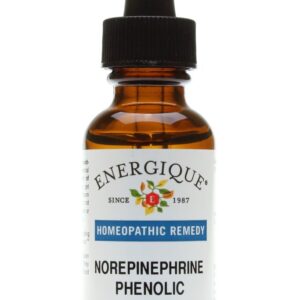
→ Norepinephrine Phenolic: Norepinephrine, a neurotransmitter, is of great benefit for chronic depression and hypertension. We have seen effectiveness, as well, in tachycardia and hyperhydrosis (excessive sweating). Curiously, it often seems to help memory retention.
Norepinephrine Phenolic contains norepinephrine 6x, 12x, 30x, 12c, 30c and distilled water. 20% ethanol.
→ Phenylalanine Phenolic: Phenylalanine is an amino acid that is basic to most of nature. In plants, it is the first phenolic step in the creation of cinnamic acid, caffeic acid, coumarin and coniferyl alcohol. In humans and other higher life forms, phenylalanine is an important building block to a wide number of functions. Most important is its function in building the neurotransmitters of the dopamine-epinephrine pathway. Phenylalanine is also important in the building of several proteins in the body.
Phenylalanine greatly affects mood and behaviors. We note its best benefits with headaches and depression, but it has also helped with sleep problems and blurring vision. In addition, phenylalanine is known to block the appetite-controlling transmitter serotonin, and its neutralization may reverse that process.
In food, the three biggest food sources are milk, beef and bananas.
Phenylalanine Phenolic contains phenylalanine 6x, 12x, 30x, 12c, 30c and distilled water. 20% ethanol.
→ Phenylisothiocyanate Phenolic: Phenylisothiocyanate, often referred to as P.I.T. for short, is an antithyroid compound. In sustained exposure, it is goitogenic.
P.I.T. is primarily a mustard family chemical, but is found in crucifers and legumes, as well. The chemical has an interesting history, because of its importance in plant breeding circles. It first came to light for its fungicidal characteristics; and in generations of hybrids of soybean, it has ever increasing concentration. Early strains of soy were measured at 2 ppm, while recent strains range upward to between 1,500 and 2,200 ppm.
P.I.T. has a great affinity for amino acids and sulfur-based compounds. In the phenolic circles, it has been used primarily for its influence on diarrhea and the cardiovascular system. It often benefits those suffering from chronic arrhythmias and hypertension. Because P.I.T. is antithyroid, dilutions of it should theoretically be of benefit in balancing the thyroid. How effective it is remains to be tried.
Phenylisothiocyanate Phenolic contains phenylisothiocyanate 6x, 12x, 30x, 12c, 30c and distilled water. 20% ethanol.